Sociolinguistic Perception in Music
Do you ever picture an artist when you listen to music? Have you ever wondered how the way that an artist sings or presents themselves influences your perception of who they are? In the digital age, music is much more than just what you hear! It’s a carefully curated, highly cultural blend of auditory cues, and visual imagery through which listeners construct social meaning and identity. My dissertation seeks to understand how we draw on all of these cues, as well as our own lived experiences and beliefs about how the world works, to form impressions about who artists are and whether or not they seem ‘authentic.’
My dissertation explores how American audiences construct perceptions of racial identity and notions of authenticity in pop music. In particular, I examine how listeners respond when an artist’s voice and appearance challenge dominant expectations about race and language (raciolinguistic ideologies). For example, what happens when a White singer uses features of African American English (AAE)? Do listeners hear or recognize those racialized features or they mostly go unnoticed in the context of performance? How do audiences decide whether a performance feels ‘authentic,’ ‘inauthentic,’ or ‘appropriative’?
To answer these questions, I use three complementary studies that examine sociolinguistic perception from different angles:
- Eye-Tracking: Participants listen to pop music while viewing images of singers’ faces as an eye-tracker records their gaze in real time. This study investigates how how listeners process linguistic and visual information simultaneously and whether certain voice-face pairings create moments of surprise or uncertainty.
- Matched-Guise Surveys: Participants evaluate singers performing in both an AAE and Mainstream U.S. English guise under auditory-only and audiovisual conditions. This study examines how the addition of visual cues influences perceptions.
- Sociolinguistic Interviews & Stance-Taking Analysis: Through interviews and open-ended survey responses, I investigate the broader beliefs and assumptions participants draw upon when discussing race, language, and authenticity in pop music. This study examines how listeners make sense of, authenticate, or delegitimize White artists who use AAE features in performance.
By combining these approaches, these studies bridge the gap between listeners’ implicit, automatic perceptions and their explicit, conscious explanations, shedding light on the broader cultural beliefs that underlie understandings of race, language, and performance.
Abstract from a pilot project (earlier work in this area of inquiry)
Sounding Black, Looking White: Perceptions of Racial Identity in Pop Music
Background. Prior research on linguistic appropriation in American media shows that White artists often engage in linguistic minstrelsy (e.g., Bucholtz & Lopez, 2011; Eberhardt & Freeman, 2015), adopting linguistic features associated with African American English (AAE) and other racialized varieties for commercial and social gain. While such appropriation has been extensively explored at the production level, there remains a critical gap in understanding how American audiences perceive and evaluate these racialized linguistic cues in performative contexts. This study investigates how listeners interpret AAE use by both Black and White artists, shedding light on the implicitly understood boundaries of appropriation in pop music.
Stimuli. Four professional American singers (Black female, Black male, White female, White male) were recruited to perform two mini pop songs (2.5 minutes), created for this study. Each song featured matched lyric pairs, with the first line including 1-3 AAE features, followed by a version in Mainstream U.S. English (MUSE). To visually represent the singers, four normed faces (Black female, Black male, White female, White male) were selected from the Chicago Face Database (Ma et al., 2015).
Methods. This two-part study included 23 focus groups (N = 36) and an online survey (N = 157). The focus groups followed a semi-matched guise design and allowed for exploratory discussions. Participants listened to each singer perform in either the AAE and MUSE guise, then qualitatively evaluated their stylistic ‘authenticity.’ Next, they compared AAE/MUSE lyric pairs to identify any perceived linguistic differences and reflected on which version felt more fitting. Finally, participants were shown each singer’s purported face to assess racial expectations.
In the survey, participants listened to audio clips of singers performing isolated lyric clips in one guise, evaluated each singer across six dimensions (confidence, experience, smoothness, authenticity, sexiness, trendiness), and then indicated the perceived race of the singer. Next, participants were shown a ‘headshot’ of each artist and were asked to re-rate them across the same six dimensions to determine the influence of visual cues.
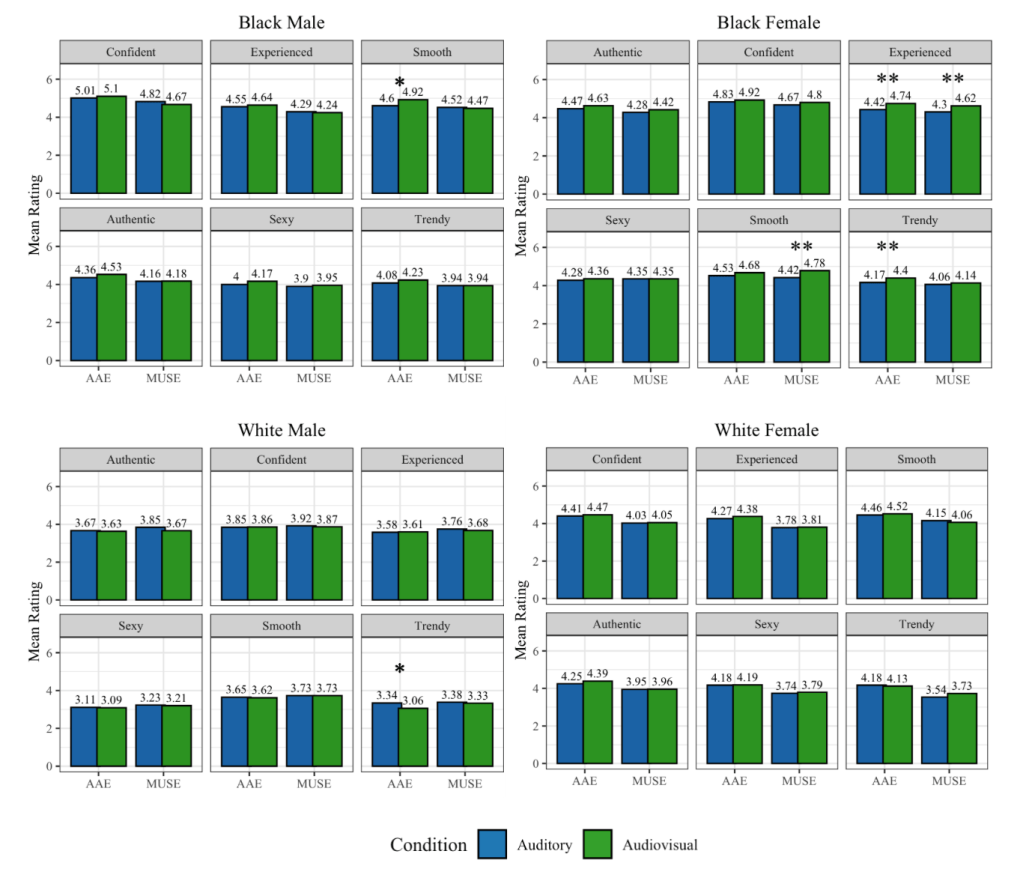
Findings. Participants consistently exhibited lower accuracy in identifying the racial identity of the White singers, particularly the White male singer performing in the MUSE guise (Figure 1 & Table 1). Across all singers, the AAE guise was generally preferred over MUSE versions of the lyrics, which may indicate that AAE is largely normalized within the pop genre. The presence of visual cues had minimal effects on how participants rated each singer (Figure 2), suggesting that White artists performing in the AAE guise were not necessarily viewed less favorably when their racial identity was made visually explicit.
These findings contribute to broader discussions on how Black linguistic practices are systematically commodified and repackaged by White artists in the American music industry. This study also highlights the role of genre and racial ideologies in shaping listener expectations, suggesting that linguistic appropriation in music represents a contested site of ideological negotiation, where artist authenticity, genre-appropriate conventions, and the commercially-driven imperatives of the music industry all converge, each fundamentally shaping how audiences consume, interpret, and anticipate musical performances.
Figure 1. Racial Identity Guess Accuracy by Singer and Guise (Focus Group).
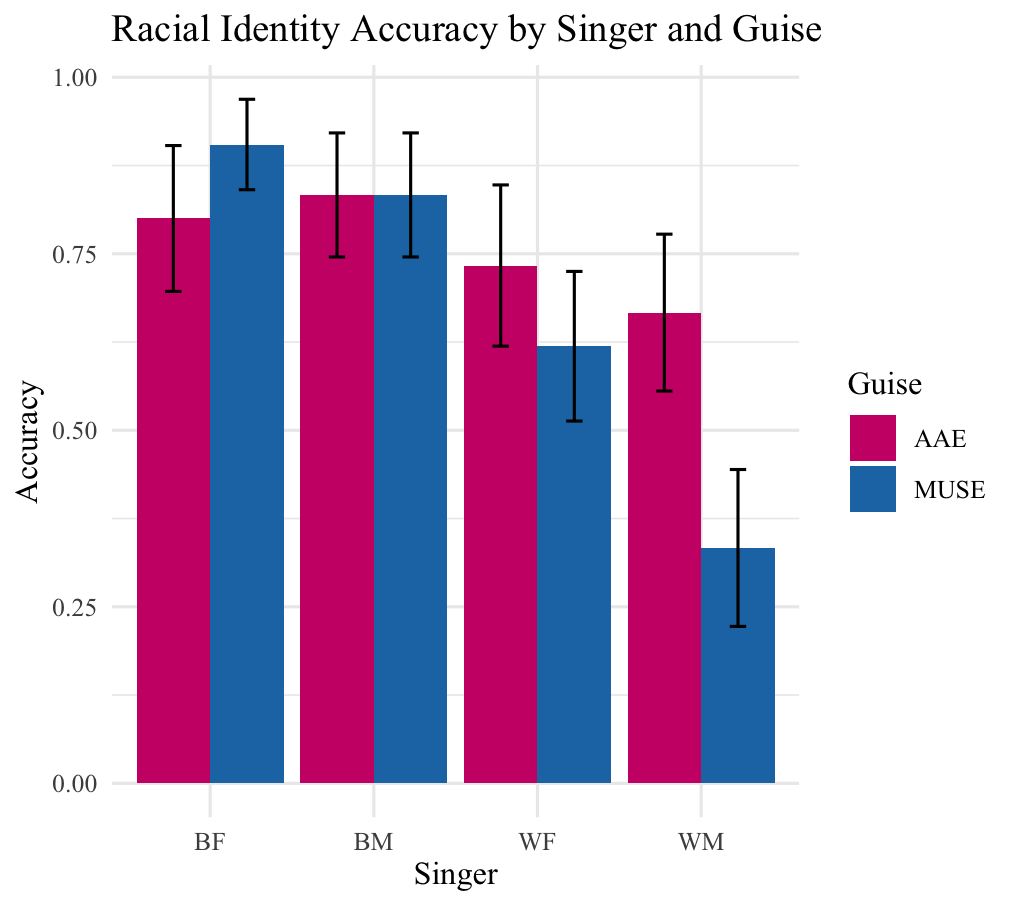
Table 1. Racial Identity Guess Accuracy by Singer, Guise, & Self-Reported Confidence Interval (Survey).
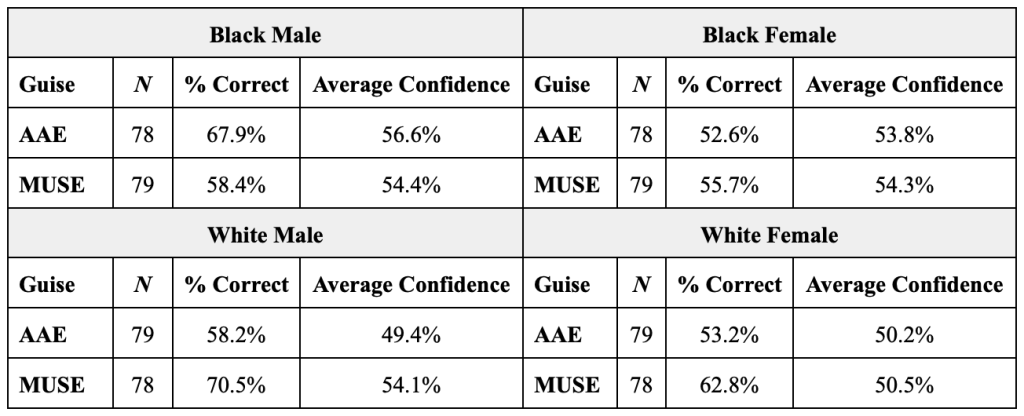
Figure 2. Mean Ratings of Singer Attributes Across Auditory/Audiovisual Conditions and by Guise (Survey). Note: Attributes showing significant differences are indicated by asterisks (*p < .05; ** p < .01).
Language Attitudes
Language attitudes are evaluative reactions to the way people speak or certain linguistic features that different groups use. Understanding how people feel about the way others use language is an important aspect of sociolinguistics because it helps us better understand how certain language features gain various social meanings and become associated with specific social groups and contexts.

My work aimed to explore how people feel about voseo, a second-person singular Spanish pronoun used to informally address someone as “you” on social media platforms. To do this, I used a mixed-methods approach, combining (1) sentiment analysis (to determine if commenters show positive, neutral, or negative sentiment towards voseo), (2) ordinal and multiple logistic regression models (to understand how different factors influence sentiment towards voseo), (3) thematic analysis (to identify recurring themes and attitudes), and (4) an analysis of epistemic stance-taking (to examine how commenters position themselves in terms of knowledge about voseo), to gain an complete understanding of how voseo is evaluated from a global, regional, and individual level.
Findings illustrated that most commenters exhibited negative sentiment towards voseo. However, sentiments varied depending on each individual’s regional and experiential background. This research sheds light on the complex and dynamic nature of language attitudes towards voseo and reveals how deeply ingrained social and cultural biases can influence our perceptions of arbitrary language features. By studying these attitudes, we can better recognize broader social dynamics at play and work towards a more inclusive, scientifically-informed understanding of linguistic diversity.
Abstract
Digital Metacommunication: Exploring Language Attitudes towards Voseo across Social Media Platforms
Background. Language attitudes encompass evaluative reactions to language, reflecting internalized beliefs about linguistic elements and the individuals who use them (Dragojevic et al., 2020). These attitudes shape how language is implemented, creating variation that, “constitutes an indexical system that embeds ideology in language and that is in turn part and parcel of the construction of ideology” (Eckert, 2008: 454). As linguistic expression has evolved alongside technological innovation, so has language attitudinal research expanded to incorporate the digital linguistic landscape of social media. This research embarks on a pioneering exploration of perceptions and sentiments of the second-person singular pronoun, voseo, as expressed in the comments of social media platforms TikTok, Instagram, and YouTube.
Method. Building upon the limited research that has utilized social media for attitudinal data collection (Cutler, 2016; 2019; Durham, 2022), all collected data was manually assembled into a corpus of 2,140 comments left by users from 20 Spanish-speaking countries. This study used a mixed-methods approach, combining sentiment analysis, multivariate and ordinal logistic regression models, and qualitative analysis to fully gauge how attitudes are shaped by variables indicated in prior research, including a commenter’s country of origin and voseo’s associations with informality, solidarity, regional identity, and social stigma (Carricaburo, 2015; Raymond, 2016).
Results. The quantitative analysis depicts polarized sentiments regarding voseo, indicating strong opinions among social media users. These evaluations are shaped by additional variables identified in the qualitative analysis, such as prescriptivist beliefs, dialectal contact, linguistic heritage, aesthetics, associations with homosexuality, and discriminatory, ethnocentric attitudes. The findings reveal a complex interplay between language, identity, and digital communication, underscoring the significant role of digital platforms in constructing and disseminating linguistic ideologies.
Conclusion. This research enhances our understanding of language attitudes expressed in a digital context by providing a valuable snapshot into the expanding constellation of indexical meanings associated with voseo.
Performative Language & Style
Have you ever wondered why artists sometimes sound different when they sing than when they speak offstage? Why did the members of One Direction sound American in their songs despite being from the UK? Why did White Australian rapper Iggy Azalea adopt African American English (AAE) features in her music? These kinds of questions prompted me to study how Justin Bieber used AAE features throughout his career. For linguists, this phenomenon of is fascinating because language is a primary way people construct and perform identity. The issue becomes even more complex when we consider the use of racialized linguistic features.

African American English (AAE) has long been stigmatized when used by Black speakers. At the same time, however, it is also associated with desirable social qualities like being ‘cool’ or ‘rebellious.’ In performative contexts, White artists have often used AAE to project such qualities for social and commercial gain. To explore this phenomenon, I analyzed all of Justin Bieber’s songs and a selection of his interviews spanning more than a decade of his career. I documented his use of AAE features and compared his patterns to other famous White and Black artists (Chance the Rapper, Lizzo, Meghan Trainor, Post Malone, Ariana Grande).
One of the most interesting findings was that Bieber was more likely to use certain features of AAE when collaborating with Black artists. But his use of these features was far from consistent, varying considerably across songs and contexts. Ultimately, this project left me with bigger questions that I would later investigate in my dissertation project: How do audiences interpret these performances by White artists? How do they decide what counts as appropriation?
Abstract
Adopting Black Speech in Popular Music: A Sociolinguistic Analysis of Justin Bieber’s Invented Identities
Background. Although all language could be considered to be ‘performative’ in the sense that every individual both consciously and unconsciously uses language to index their own identities (Eckert 2008, 2012; Goffman 1981), the study of performative linguistics seeks to understand the behavior and motivations behind all instances of the ‘high performance’ of language (Coupland 2007) where certain performers purposely stylize their speech, mannerisms, and appearance in order index a certain identity whether or not they have the social license to claim membership within said identity (Bell and Gibson 2011). Building upon Alim’s (2002) study of Hip Hop artists Eve and Juvenile and Eberhardt and Freeman’s (2015) analysis of Iggy Azalea, this linguistic case study on Justin Bieber’s use of Black speech features both on and off stage adds quantitative evidence to the limited but growing pool of sociolinguistic data that measures the extent to which White American artists appropriate Black speech features to accumulate social and commercial success.
Method. In this study, I transcribed Justin Bieber’s second and most recently released album (My World 2.0 (2010) and Justice (The Complete Edition) (2021)) as well as five 10-30 minute interviews and live streams that each feature various social contexts. Throughout the duration of this study, I took into account every instance in which Justin Bieber utilizes Black phonological, morphosyntactic, and lexical features. Following Alim’s (2002) and Eberhardt and Freeman’s (2015) analytical model, the principal conclusions of this study are derived from a statistical analysis of Bieber’s rate of copula absence in comparison to previous copula data gathered from five other Black and White Hip Hop artists (Eminem, Iggy Azalea, Eve, Juvenile, Trina).
Results. One crucial factor that contributed to Bieber’s adoption of Black speech features emerged from the data. Justin Bieber was more likely to omit the copula in songs in which he features (feat.) a Black artist, which indicates a regular practice of dialectal accommodation (Nycz 2019). To my knowledge, no other sociolinguistic study of Hip Hop artists has expressly analyzed the unique sociolinguistic environment of a musical collaboration with another artist. This study establishes that ‘feat.’ merits a fixed, noteworthy space to socially and linguistically interact with another speaker.
The results demonstrate that Justin Bieber does not utilize Black speech features consistently, but instead chooses to sparsely and haphazardly employ various Black features. This behavior suggests a lyrical routine of code-crossing, defined by Rampton (2017) as a code alternation performed by speakers who lack social provision to speak an ethnically-marked dialect. Given Justin Bieber’s fundamental lack of understanding and familiarity with African American English in conjunction with his choice to omit the copula at a surprisingly higher rate than other White artists such as rapper Eminem (Eberhardt and Freeman 2015), the data reveals a fickle, inconsistent linguistic performance wrought by Bieber in the hopes of constructing a more “street-conscious”, legitimate Hip Hop persona.Conclusion. The summary of Justin Bieber’s attitudes and behaviors only adds to the historical consistency of White artists appropriating and commodifying Black identity for their own personal benefit. Although the Global Hip Hop Nation is inclusive of all creators from widely disparate racial and linguistic backgrounds, Justin Bieber’s demonstrative patterns of linguistic mimicry and racially insensitive behavior connotes an attitude of entitlement and a complete disregard of how he, as a White artist, is not subject to the oppression of systemic racism in the U.S. Yet despite many blatant forms of racial appropriation, Bieber continues to remain one of the most successful artists in the world whose fame is cushioned on the innumerous, unacknowledged privileges that his whiteness affords him.
Media’s Role in Language Variation and Change
Is media changing the way that we speak? In the digital age, where the average American spends about 8 hours per day with digital media (Guttman, 2023), media’s role in the processes of language variation (how language changes) remains largely unknown and non-empirically established. A new theoretical model is needed that considers (1) the amount of media exposure and (2) the depth of user engagement with media content. For a proposed study, I hope to empirically evaluate the role of new media in individual-level dialectal change, integrating theories from media effects research, behavioral psychology, and sociolinguistics. The findings of this study are expected to significantly advance sociolinguistic models of dialect change in an increasingly digitalizing world, integrating media exposure and engagement as components of linguistic variation to better understand why and how media contributes to dialectal acquisition and change.


Abstract
Echoes of Digital Voices: The Role of Media Engagement on Intraspeaker Dialectal Variation and Change
Despite the rapid increase of media usage in the United States, where individuals average eight hours per day consuming media (Guttmann, 2023), the role of digital media in language variation remains ambiguous and largely unexplored (Sayers, 2014; Trudgill, 2014; Nycz, 2019; Starr, 2019). This project aims to empirically evaluate the impact of media engagement on individual-level dialectal change among native New York City English speakers exposed to Canadian English through various digital platforms. Building on the media debate in the Journal of Sociolinguistics (18/2), this study integrates theories from media effects research (Bimber et al., 2012; Gunter, 2014), behavioral psychology (Gerbner et al., 1980; 2002), and sociolinguistics to analyze how both exposure and engagement contribute to the modern dynamics of intraspeaker dialectal variation and change in an increasingly digitalizing world.
Previous literature has noted a gap in understanding how indirect, media-based linguistic input affects dialectal change at both community and individual levels (Stuart-Smith et al., 2013; Sayers, 2014). While traditional research emphasizes face-to-face interaction as essential for dialectal change (Trudgill, 1986; Chambers, 1992; Labov, 2007), recent findings suggest that media also plays a role in improving cross-dialectal awareness of second dialect features (Walker, 2018; Lincoln & Starr, forthcoming) and accelerating dialectal changes (Stuart-Smith et al., 2013; Starr, 2019). This study proposes a new theoretical model that incorporates both the quantity of media exposure and the depth of user engagement as key factors that may influence individual-level dialectal change. Furthermore, drawing on Goldinger’s (1998) Exemplar Theory, this work seeks to contribute to broader theoretical understandings of how media engagement not only embeds new linguistic exemplars into memory, but also fosters parasocial relationships with content creators. Through empirical investigation, this study aims to clarify the extent to which media engagement may or may not amplify the salience and influence of these exemplars on dialectal variation (Gunter, 2014).
The project will involve a mixed-methods approach, collecting data from a diverse group of 30-60 native New Yorkers. Participants will be stratified into three groups based on their exposure to Canadian content creator Kurtis Conner: New Viewers (less than 1 year), Regular Viewers (1-3 years), and Long-Term Viewers (over 3 years). The study will monitor changes in stable Canadian English features, such as the CAUGHT-COT merger and Canadian Raising (Newman, 2014; Nycz, 2016; Denis et al., 2023), which are generally absent in NYC English. New Viewers will engage with media content for 90 days and will log all interactions on the following platforms: TikTok, Instagram, and YouTube. To track any dialectal shifts, sociolinguistic interviews will be conducted at the beginning, middle, and end of the data collection period, and will be complemented by surveys assessing participants’ social networks, language attitudes towards both dialects, and feelings of interpersonal attachment to the Canadian content creator. Analytical methods will include regression models to identify the effects of media engagement on dialectal changes, alongside qualitative analyses of epistemic stance-taking to better understand how media affects personal constructions of place-identity and authenticity (Heritage, 2012a; 2012b; Bucholz & Hall, 2005; De Jesus et al., 2024).
The findings of this study are expected to significantly advance sociolinguistic models of dialect change by integrating media exposure and engagement as factors in linguistic variation.

